

Table of Contents expand_more
Why cold email still matters in 2026
Think cold email is dead? Not even close. Despite the rise of social selling and AI chatbots, cold email remains a foundation for B2B lead generation, partnership outreach, recruitment, and fundraising. Over 51% of businesses rely on cold email as a primary outreach channel, and response rates for well-crafted campaigns hover between 8-12%, far above many other channels.
Cold email cuts through the noise, reaching decision-makers directly and efficiently. But the landscape has evolved. What worked in 2023 won't cut it in 2026. The game is smarter, more automated, and deeply personalized.
of B2B businesses use cold email as primary outreach
reply rates for well-crafted cold email campaigns
reply rate with deep personalization (vs 5% generic)
What is cold email? (and how has it changed?)
Cold email is any unsolicited email sent to a recipient who doesn't know you. Traditionally, it meant mass blasts and generic templates. Today, it's smarter and more targeted. Cold email is now about relevance, timing, and personalization, backed by data, automation, and ethical practices.
Cold email isn't spam when you provide value, clarity, and consent. Modern cold emailing prioritizes relationships, not transactions.
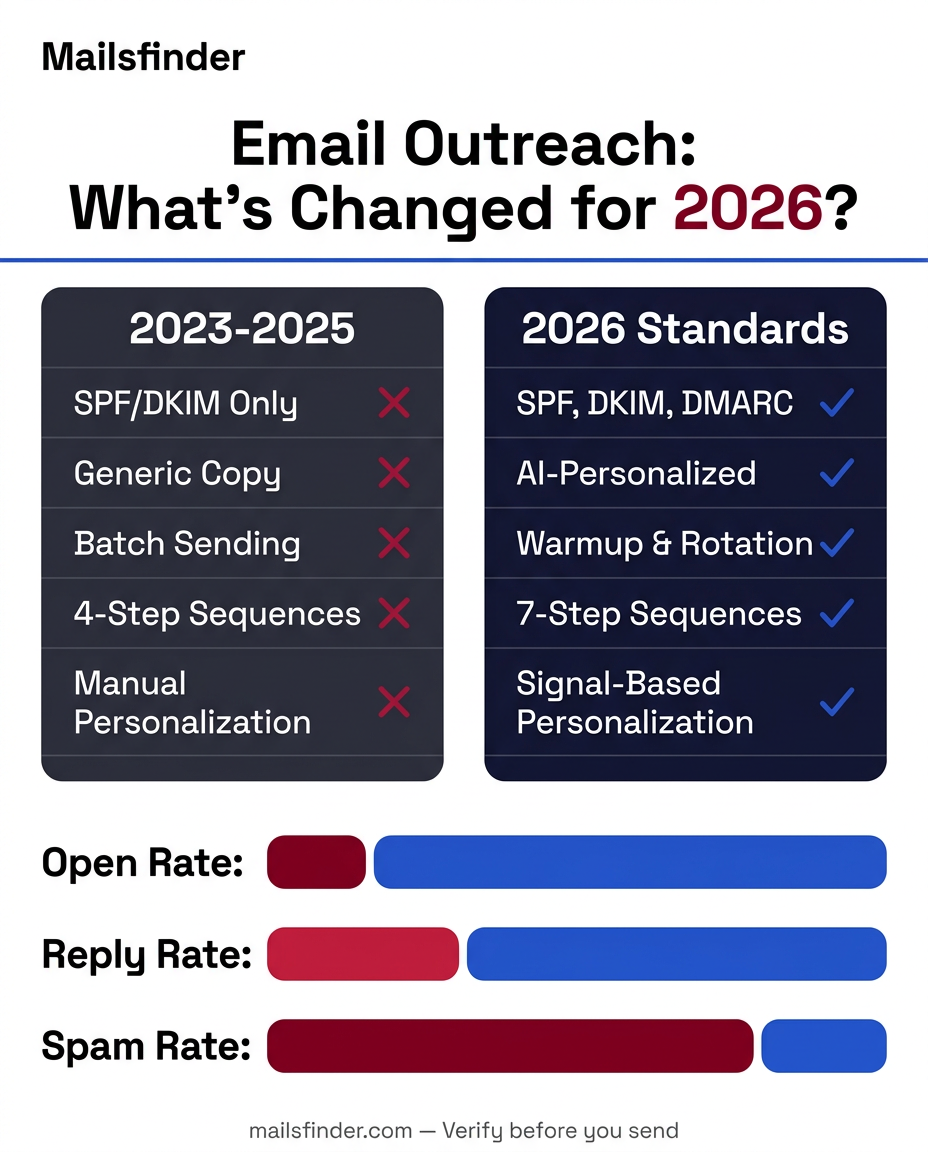
2026 advancements
AI-driven personalization
Using behavioral and firmographic data to craft messages that feel hand-written, at scale.
Dynamic engagement tracking
Real-time deliverability monitoring and signal-based follow-up triggers.
Compliance with evolving privacy laws
GDPR, CAN-SPAM, and CCPA compliance is now enforced at the infrastructure level.
The step-by-step cold email framework
Your cold email campaign lives or dies by the process behind it. Follow these 7 steps to build campaigns that consistently land in inboxes and generate replies.
Strategic target list building
The foundation of every successful cold email campaign is your list. In 2026, list quality trumps quantity. A hyper-targeted list can outperform a massive list by up to 3x in reply rates.
Build your list right
Identify ideal buyer profiles using predictive analytics and firmographic data
Source verified contacts from platforms like LinkedIn, Apollo, and Mailsfinder
Segment lists by intent, industry, role, and engagement likelihood
Verify every email before loading it into your sending tool
Verify your list before you send
Bounce rates above 2% trigger enforcement from Gmail and Yahoo. Mailsfinder verifies emails with 99% accuracy so you only send to real inboxes.
Crafting compelling subject lines
Your subject line is your first impression. 80% of recipients decide to open based solely on this. Subject lines under 35 characters outperform longer ones. Personalization referencing recent activity (event attendance, new hires, funding rounds) drives up to 50% more opens.
Hyper-relevance
"Quick question about your January product launch"
Intrigue (no clickbait)
"AI workflow insights for [Company]?"
Data-driven
A/B test subject lines and use AI tools to optimize open rates
Pro tip: Subject lines under 35 characters outperform longer ones. Reference something specific, like a recent funding round, job posting, or conference appearance, to cut through inbox noise.
Writing high-converting body copy
Anatomy of a modern cold email
Personalized intro
"Saw you spoke at SaaS Leaders Summit, impressive insights!"
Crystal-clear context
"I'm reaching out because our AI workflow tool saved X company 12 hours/week."
Value proposition (not a pitch)
"I thought you'd appreciate a quick demo, no sales pressure."
Soft call to action
"Would you be open to a 10-minute Zoom next week?"
Weak email
"Hi, I'd like to tell you about our software that helps your business grow. Let me know if interested."
Strong email
"Hi Sarah, I noticed your team recently expanded sales operations. Last month, we helped [Competitor] cut manual work by 20 hours/week. Open to a quick chat?"
2026 best practices
- arrow_forward Keep emails under 120 words for initial touch
- arrow_forward Use storytelling and social proof instead of feature lists
- arrow_forward Include a clear but soft CTA, never hard-sell on first touch
Advanced personalization: AI and beyond
Real personalization isn't just swapping first names. Fully personalized emails (beyond name/company) achieve a 17% reply rate, versus 5% for generic bulk emails.
Recent news triggers
Mention relevant company news, funding rounds, or leadership changes.
Behavioral triggers
Action-based follow-ups: "Saw you downloaded our whitepaper."
Industry pain points
Tailor by vertical-specific challenges to show deep understanding.
The personalization gap
Reply rate with deep personalization
Reply rate with generic bulk emails
Scheduling and sending: timing is everything
Leverage AI-powered scheduling tools to optimize for when your prospect is most likely to engage, using past inbox activity and timezone data. Use staggered sending to dodge spam filters.
Optimal send times in 2026
Best days
Wednesdays and Thursdays, 9-10am local time
Worst days
Fridays and Mondays (lowest engagement rates)
Follow-up sequencing
Most replies come from follow-ups, not first emails. Set an intelligent follow-up cadence that adds new value with each touch. Automate without losing personalization by using tools that trigger on engagement signals (opens, clicks, replies).
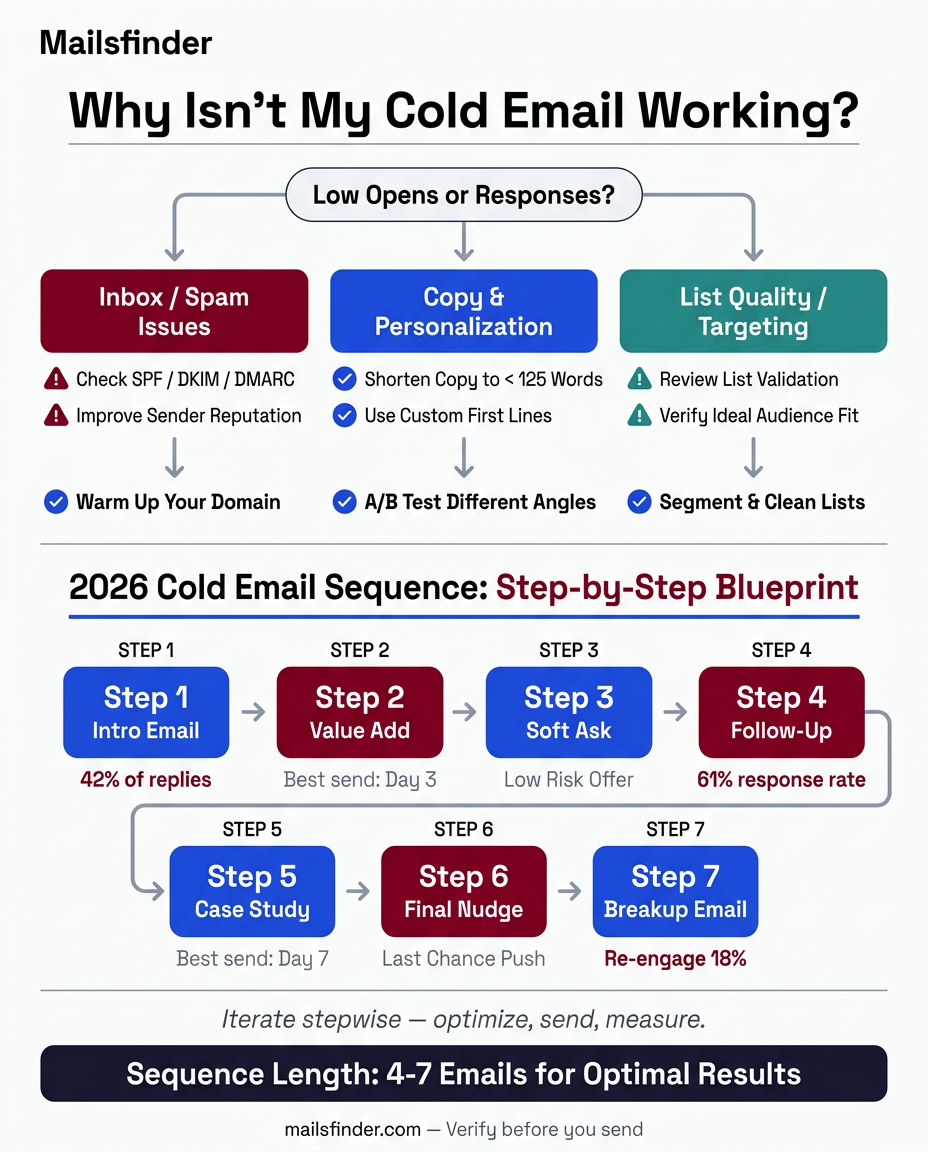
2-3 days after initial email
New angle or value. Don't just "bump" the thread. Add a case study, data point, or relevant insight.
5-7 days after first follow-up
Reference the previous touch. Share a relevant resource, article, or social proof from a similar company.
10-14 days later
Offer a new resource or insight. Breakup email if no response. Give them an easy out while keeping the door open.
Tracking, measuring, optimizing
Measure what matters: open rates, reply rates, conversion to meeting/demo, bounce rates, and spam complaints. Iterate by A/B testing subject lines, CTA phrasing, and personalization depth.
Open Rate
40-60%Reply Rate
8-12%Bounce Rate
<2%Spam Rate
<0.1%Compliance, ethics, and deliverability
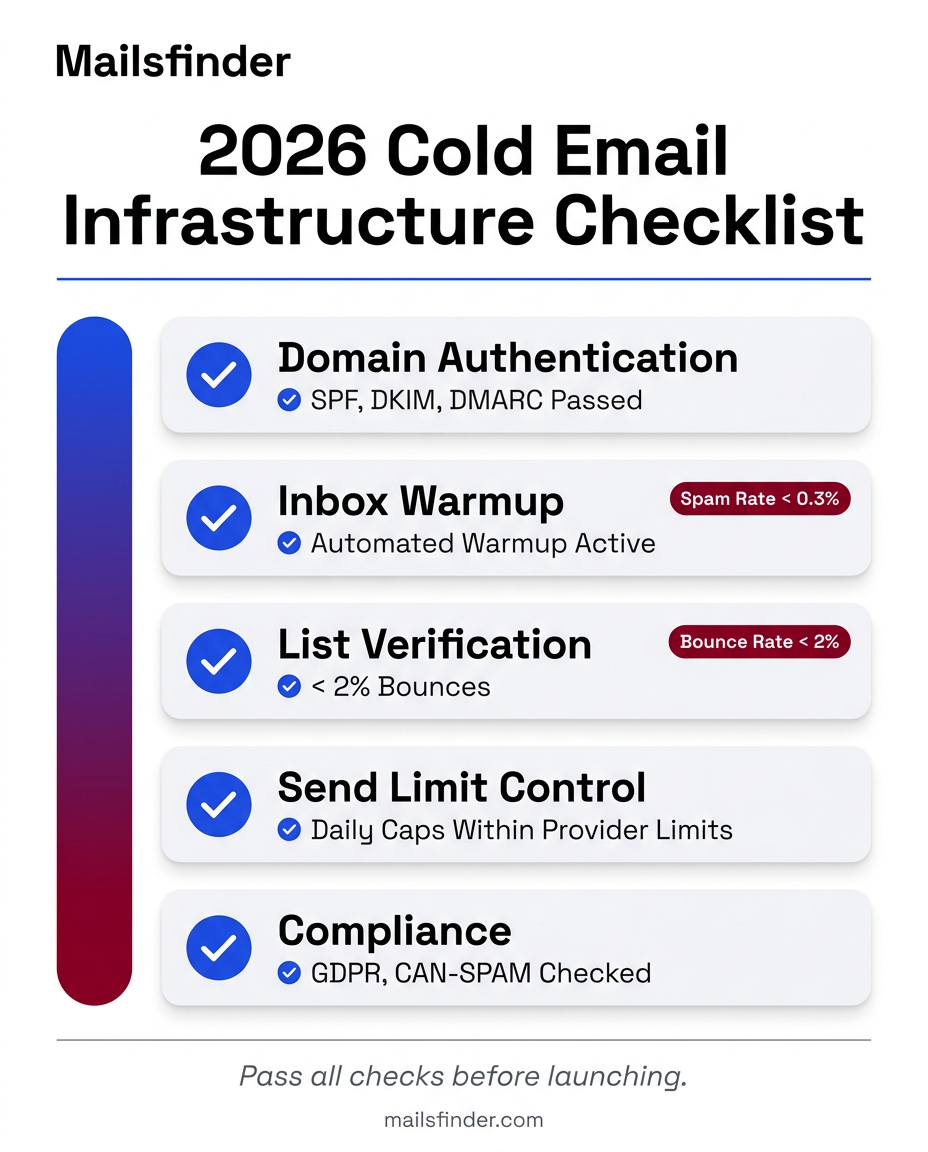
Don't risk your reputation. The technical side of cold email is just as important as the copy. Without proper authentication, clean lists, and compliance, your emails won't reach anyone.
Authenticate your domains
SPF, DKIM, and DMARC are mandatory in 2026. Emails without them get rejected, not just filtered to spam.
Clean lists frequently
Bounce rates above 2% trigger enforcement from Gmail and Yahoo. Verify emails before every campaign.
Honor privacy laws
GDPR, CAN-SPAM, CCPA. Always include an unsubscribe mechanism and honor opt-outs within 2 days.
Warm up your inboxes
New domains need 2-4 weeks of warmup before any cold sending. Never skip this step.
Need help setting up your infrastructure?
Read our complete guide on domains, DNS, mailboxes, warmup, and sending tool setup.
Exclusive Bonus
Join my Inner Circle, get free access to Mailsfinder (500K credits)
Get everything you need to launch and scale cold outreach. My Inner Circle members get 500K Mailsfinder credits included with their membership, plus the full outbound playbook library.
$249 one-time · No recurring fees
Cold email tools and tech stack for 2026
To scale cold outreach, you need the right stack. Here's what the best outbound teams are using in 2026.
Real-life cold email examples that work
SaaS partnership outreach
"Hi Jenny, I read your interview about scaling [Company]'s user base. Our SaaS team specializes in onboarding and reduced churn for platforms like yours. Open to exploring a partnership?"
Why it works: Personalized by content reference, clear value, non-pushy CTA.
Event lead follow-up
"Hey Tom, great meeting you at FinTech Innovations. I'd love to continue our conversation about AI-powered customer experiences. Are you free for a brief call next week?"
Why it works: Timely, context-driven, natural follow-up.
Recruitment outreach
"Hi Priya, saw your portfolio on GitHub, impressed by your ML projects. Wondering if you'd be interested in a remote engineering role at [Company]? Happy to share details."
Why it works: Specific, respectful, direct.
The secret sauce: what most guides miss
In 2026, the winners aren't the ones who send the most emails, but those who send the right email at the right time to the right person using the right message.
This guide goes beyond templates. It teaches you systemic thinking: be dynamic, responsive, and empathetic. Treat recipients like humans, not leads. Use your research and technology as empathy tools, not just automation levers.
Common mistakes to avoid
One mistake can cost you your sender reputation and future inbox placement. Here are the most common pitfalls.
Generic templates without personalization
Merge fields for name and company aren't enough. Reference specific, recent context.
Overly salesy language
Lead with value, not with a pitch. Your first email should feel like a warm introduction.
Sending too many emails too fast
Volume spikes trigger spam filters. Ramp up gradually and use inbox rotation.
Poor list hygiene
Unverified lists lead to high bounces and blacklisting. Always verify before sending.
Ignoring compliance and opt-outs
Missing unsubscribe links force recipients to mark you as spam, destroying sender reputation 10x faster.