

Key takeaways
- check_circleThe free tier matters more than the entry price when you are one person. Mailsfinder gives 100 credits a day forever and Skrapp 100 a month forever, both without a card.
- check_circleWatch for free tiers that expire. Tomba gives 75 lookups once and Voila Norbert 50 leads once, which is a demo rather than a tier you can work from.
- check_circlePer-seat pricing punishes small teams. Apollo is good value at $49 for 2,500 credits until you add a second person, at which point it doubles.
- check_circleCost per 1,000 found addresses runs from roughly $0.40 to roughly $280 across this list, and the cheap end is not where most people look.
- check_circleAnymailfinder bills only for verified results, and its smallest subscription tier is 400 credits a month.
- check_circleAnnual billing is the biggest lever most solo operators ignore. Hunter falls from $49 to $34 a month and Snov.io from $39 to $29.25.
- check_circleGetProspect is the only tool here that puts API access on its free plan, at 50 valid emails a month, which makes it the cheapest way to prototype an integration.
- check_circleMailsfinder is ours. Its honest limitation for this audience is no Chrome extension, so a LinkedIn-first workflow means a CSV rather than a click.
What actually makes a finder cheap for one person
Pricing pages in this category are written for sales teams. They lead with per-seat rates, credit allowances sized for a floor of SDRs, and annual contracts. If you are a founder doing your own outreach, or a team of three, most of that is noise, and the two numbers that decide your real cost are somewhere further down the page.
The first is whether the free tier renews. A tool giving 50 credits every month forever is worth far more to a solo operator than one giving 200 credits once, because the recurring one becomes a permanent part of your workflow while the other is a trial you burn in an afternoon. Four tools on this list renew monthly or daily. Three give you a one-time allowance dressed up as a free plan.
The second is what the first paid tier costs per found address, not per month. A $14 plan and a $49 plan tell you nothing until you divide by what they include. On this list the $14 option works out around fourteen times more expensive per address than the $49 one, which is the kind of inversion that only shows up when you do the arithmetic.
Per-seat pricing deserves its own warning. Several tools here charge per user, which is reasonable for a sales team and punishing for a two-person startup where both people prospect. Where a tool is priced per seat, the tables below say so, because a $49 plan is a $98 plan the moment your co-founder wants access.
The tools at a glance
How we evaluated these tools
Every tool here was judged on what a one-to-three person team would actually pay, not on the plan the vendor leads with. Pricing came from the research CSVs, re-checked against the vendor's own page where the entry predated September 2026. Ratings are shown only where our data carries a verified figure and review count.
Does the free tier renew
A monthly or daily allowance you keep is worth more than a one-time trial you burn.
Cost per 1,000 found addresses
Entry price divided by what it actually finds, which reorders the list substantially.
Per seat or per workspace
Per-seat pricing doubles the moment a second person needs access, which matters at this size.
What annual billing saves
The discount is often 20 to 30 percent and is the easiest saving a solo operator can make.
Three ways these tools price, and which suits a small team
The pricing model matters more than the headline number when your volume is small and irregular.
Per seat
Apollo charges per user. Excellent value for one person and an immediate doubling for two. Fine for a solo founder, awkward the moment you hire.
Per workspace
Mailsfinder, Hunter, Snov.io and Skrapp price the account, not the head. One bill however many of you there are, which suits a small team that all prospects.
Credit packs on top
A few vendors let you top up without changing plan. Useful when one month is busy and the rest are not, and it stops you buying a bigger subscription for a single campaign.
Every tool, side by side
Rank is a table position, not a promotional order.
| Tool | Pricing model | Entry price | Cost per 1,000 found | Free tier | Rating |
|---|---|---|---|---|---|
| Mailsfinder | Per workspace | $9.99/mo | ~$0.4 | 100 a day, forever | New on G2 |
| Skrapp.io | Per workspace | $39/mo | ~$19.50 | 100 a month, forever | 4.5/5 (329) |
| Apollo | Per seat | $49/user/mo | ~$19.60 | 75 a month per user | 4.7/5 (9,526) |
| Hunter | Per workspace | $49/mo | ~$24.50 | 50 a month | 4.4/5 (634) |
| Snov.io | Per workspace | $39/mo | ~$39.00 | 50 a month | 4.5/5 (483) |
| GetProspect | Per workspace | $49/mo | ~$49.00 | 50 valid a month | 4.0/5 (41) |
| Tomba | Per workspace | $89/mo | ~$8.90 | Trial credits | New on G2 |
| Findymail | Per workspace | $99/mo | ~$19.80 | 10 credits trial | 4.9/5 (56) |
| Voila Norbert | Per workspace | $49/mo | ~$49.00 | 50 leads once | 4.6/5 (91) |
| Anymailfinder | Per workspace | Tiers from 400 credits | Not published in USD | 7-day trial | 3.4/5 (5) |
Pricing read from the research data and vendor pricing pages in September 2026. Cost per 1,000 assumes every credit resolves into an address, which flatters the tools that charge whether or not one comes back. Order is cheapest published rate first, not a ranking. Cost per unit uses each vendor's best published rate, which is usually a larger pack or plan than the entry price in the column beside it, so the two do not divide into each other.
Cost calculator
What finding addresses costs on a small budget
Figures use each tool's entry-tier rate per found address. Tools that bill per seat are priced for one seat. Mailsfinder uses the $9.99 Starter plan at 3 credits per found address.
| Tool | Addresses you get | Rate used |
|---|
Rates from vendor pricing pages and the research data, September 2026. Where a vendor charges for searches rather than results, divide by your own hit rate for the true figure.
The tools, reviewed
Every tool gets the same card: what it is, four features, three pros, three cons, and an honest read. Same format for ours as for everyone else's.
Mailsfinder
Largest recurring free tier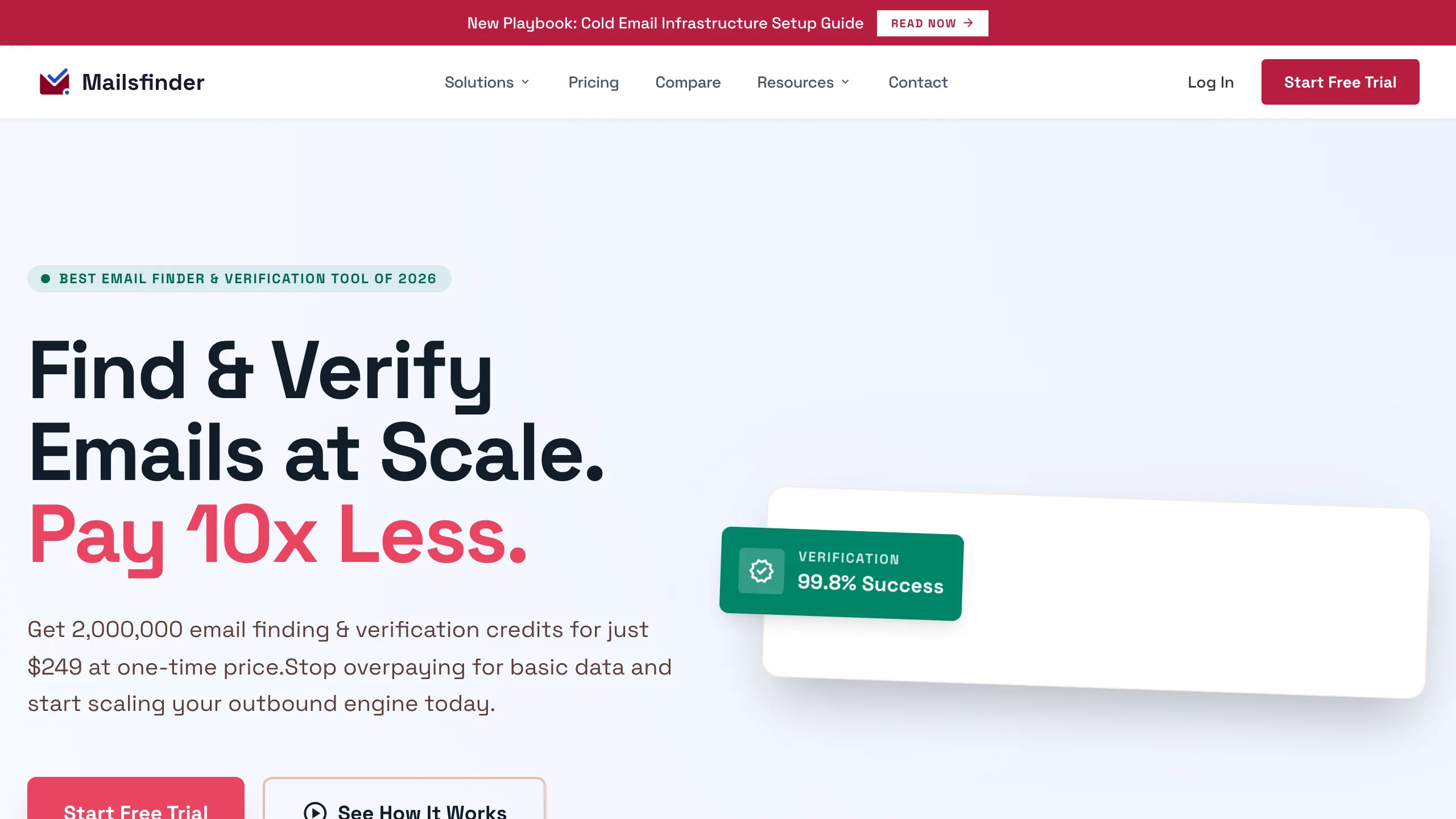
Ours, so read the cons first and check the pricing page yourself. For a solo operator the relevant number is the free tier: 100 credits a day that reset daily, roughly 3,000 a month, which covers a founder sending a few hundred emails without ever paying. A find costs 3 credits and is charged only when an address comes back, a verification costs 1, and both draw on the same pool. Starter is $9.99 for 75,000 credits a month, which works out near $0.40 per 1,000 found addresses.
Key features
- check100 free credits a day reset daily, no card, no expiry on the tier.
- checkCharged only on a hit a search that returns nothing costs nothing.
- checkOne pool for find and verify 3 credits to find, 1 to verify.
- checkPriced per workspace the bill does not move when a second person joins.
Pros
- addLargest recurring free tier on this list
- addLowest cost per found address here
- addNo per-seat charge as you grow
Cons
- removeNo Chrome extension, still on the roadmap
- removeNo API below the $19.99 Growth plan
- removeNewer platform with a thin review record
The honest read
The free tier is the real product for this audience, and the paid step up is cheap. The gap is the browser extension, so if you prospect by clicking LinkedIn profiles this will feel like extra work.
Skrapp.io
Free tier that renews, LinkedIn-first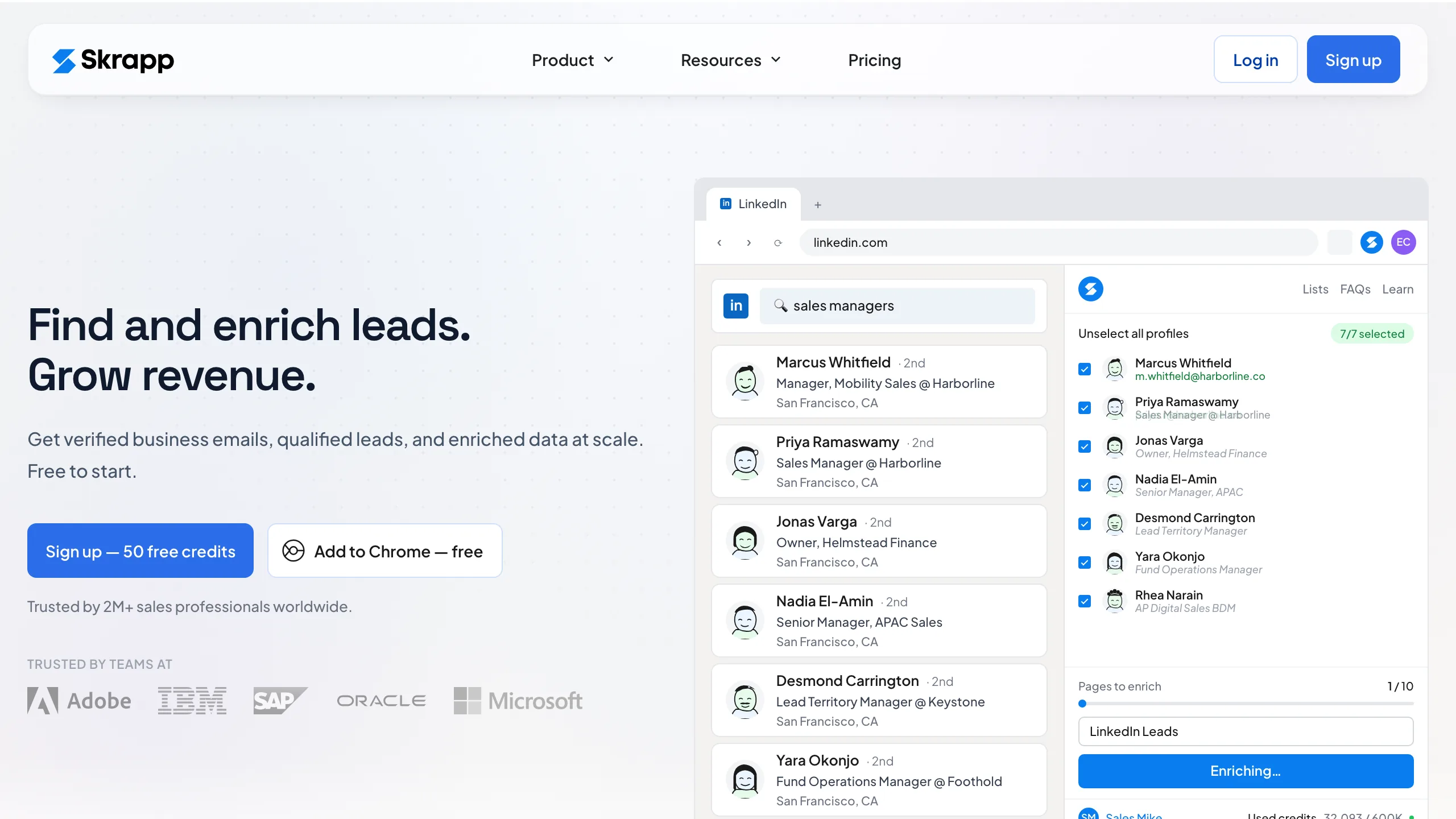
Of the LinkedIn-first tools, Skrapp has the most usable free plan for someone working alone: 100 credits every month on a forever basis, with the extension included rather than gated. Paid plans start at $39 for 1,000 credits, or $30 on annual billing, and 329 G2 reviews at 4.5 suggest the extension holds up in daily use. Paid plans bill only for deliverable results, so catch-all and invalid addresses do not consume credits, which matters on a small allowance.
Key features
- check100 free credits every month recurring rather than a one-time trial.
- checkExtension on the free plan LinkedIn and Sales Navigator, not gated behind payment.
- checkBilled on deliverable results only invalid results do not consume your allowance.
- check329 G2 reviews at 4.5 a large verified base for a tool this size.
Pros
- addFree tier renews monthly, forever
- addExtension included at no cost
- addOnly deliverable results are billed
Cons
- removeAround $39 per 1,000 credits at entry
- removeAPI access only on higher plans
- removeLittle use outside a LinkedIn workflow
The honest read
The best free LinkedIn workflow on this list. The paid step up is unremarkable value, so many solo users stay on free indefinitely, which seems to be the intent.
Apollo
Most credits per dollar, per seat
For exactly one person, Apollo is hard to beat on raw allowance: 2,500 credits for $49 a user on annual billing, alongside a database, sequences and a light CRM. The free plan gives 75 credits a month per user. The catch for a growing team is in the pricing model rather than the price, because every seat costs the same again. With 9,526 G2 reviews at 4.7 it has by far the deepest review base here, though 503 of those reviews mention inaccurate data.
Key features
- check2,500 credits per user a month the largest entry allowance among the paid plans here.
- checkDatabase, sequences and CRM more than a finder, if you will use the rest.
- checkCredit refunded on a bounce if a verified email bounces within 30 days.
- check9,526 G2 reviews at 4.7 the deepest verified review base in this comparison.
Pros
- addBest allowance per dollar for one seat
- addPlatform features beyond finding
- addLargest verified review base here
Cons
- removePer-seat pricing doubles with a second user
- remove503 G2 reviews cite inaccurate data
- removeFree plan is only 75 credits a month
The honest read
Excellent for a solo founder and an increasingly awkward bill as you hire. Verify what it returns before you send, which is true of any database this size.
Hunter
Best documented, mid-priced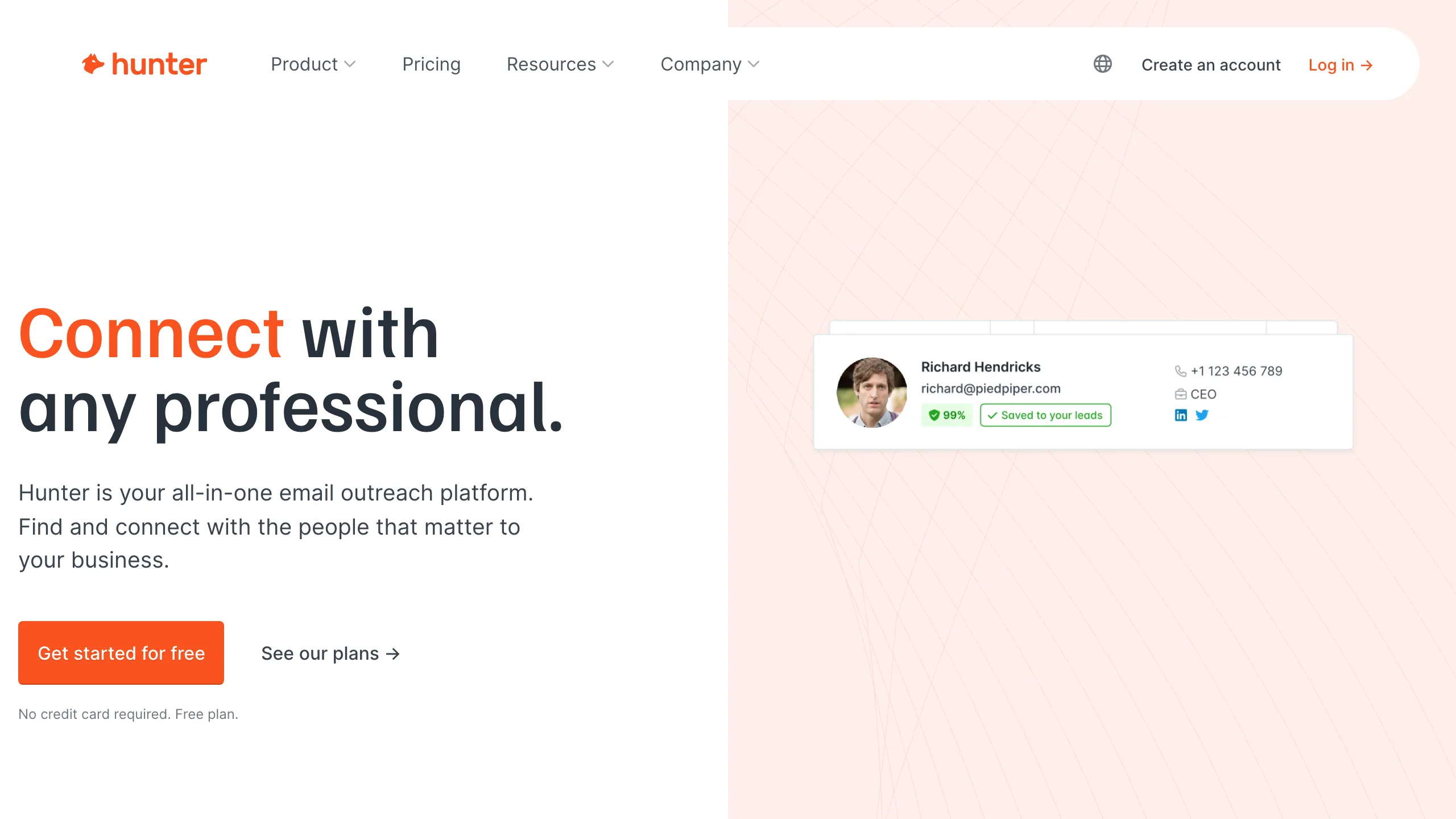
The default choice in this category, and priced like it: $49 a month for 2,000 searches, falling to $34 on annual billing, which is a 30 percent saving most solo users forget to take. The free plan is 50 credits a month and, unusually, includes API access. What you get for the money is the best documentation in the category, Domain Search alongside the finder, and 634 G2 reviews at 4.4 behind it. Independent tests put the verifier nearer 70 percent than its 91 percent claim.
Key features
- checkDomain Search as well as Finder returns every address Hunter holds for a company.
- checkAPI on every plan including free 50 credits a month is enough to prototype against.
- checkConfidence score and sources each result shows where the address was seen.
- check634 G2 reviews at 4.4 deep, long-standing feedback.
Pros
- addAPI access on the free plan
- addAnnual billing saves 30 percent
- addBest documentation in the category
Cons
- removeAround $24.50 per 1,000 searches at entry
- removeSearches billed whether or not they resolve
- removeVerifier tests below its published claim
The honest read
You are paying for reliability and documentation rather than unit price. Sensible if your time costs more than your credits, which for a busy founder it often does.
Snov.io
Finding and sending on one bill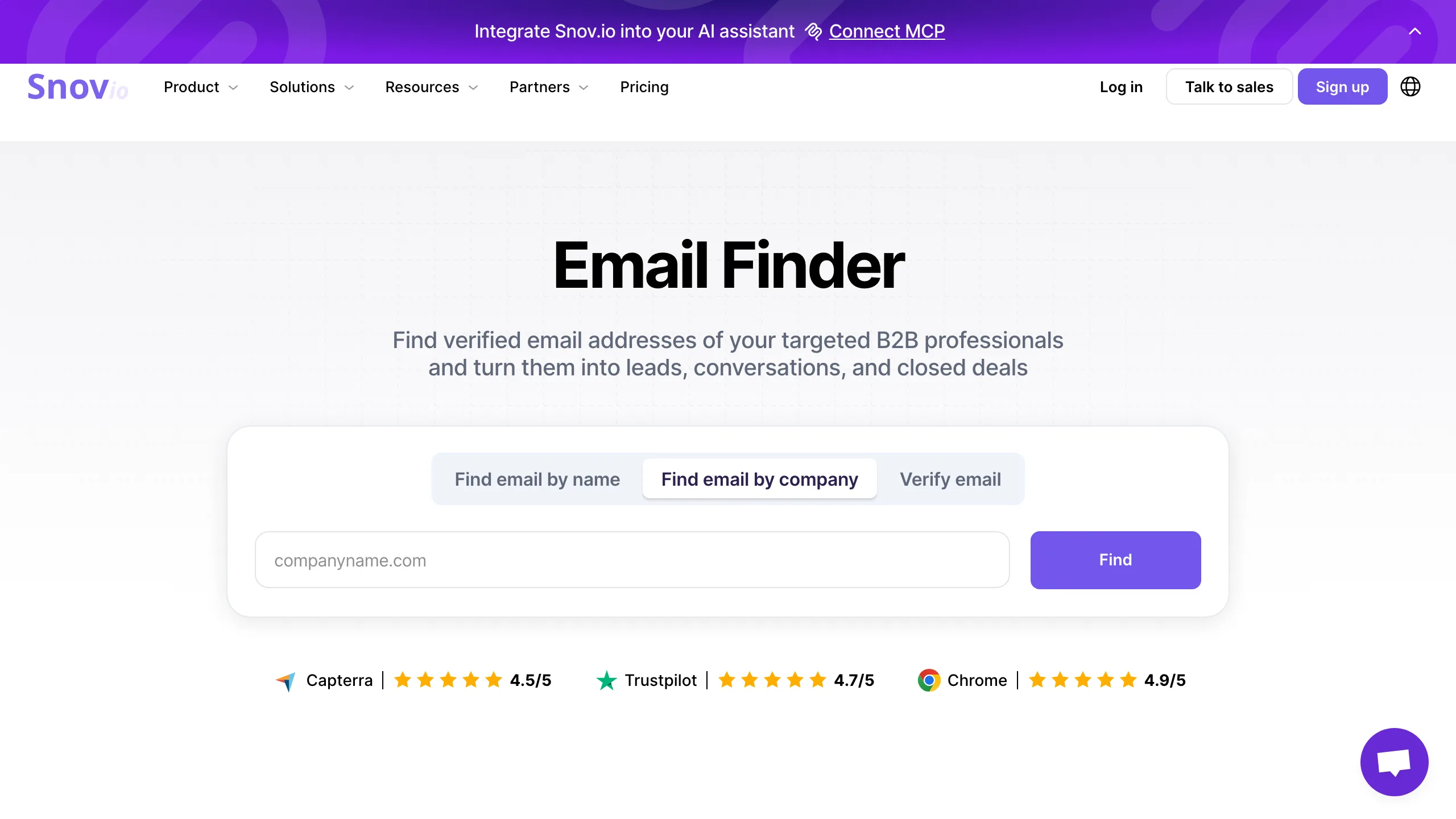
Judged purely as a finder the rate is unremarkable, but that misreads the offer: $39 buys 1,000 credits and 5,000 campaign recipients, so if you were going to pay for a sequencer anyway the effective finding cost drops sharply. Annual billing takes it to $29.25. The free plan gives 50 credits and 100 recipients a month, enough to run a small campaign end to end without paying. API access starts on the paid plans rather than the free one.
Key features
- check5,000 campaign recipients included real value if you would otherwise buy a sequencer.
- checkFinder, verifier and sending one platform, one bill, one login.
- checkFree plan sends as well as finds 50 credits and 100 recipients a month.
- check483 G2 reviews at 4.5 a solid verified base.
Pros
- addReplaces two tools on one bill
- addFree plan includes campaign sending
- addAnnual billing saves 25 percent
Cons
- removeAround $39 per 1,000 credits as a pure finder
- removeNo API on the free plan
- removePlatform complexity if you only want addresses
The honest read
Good value as a bundle and mediocre as a finder. Judge it on whether you will actually send from it, because that is where the saving lives.
GetProspect
Only free plan with API access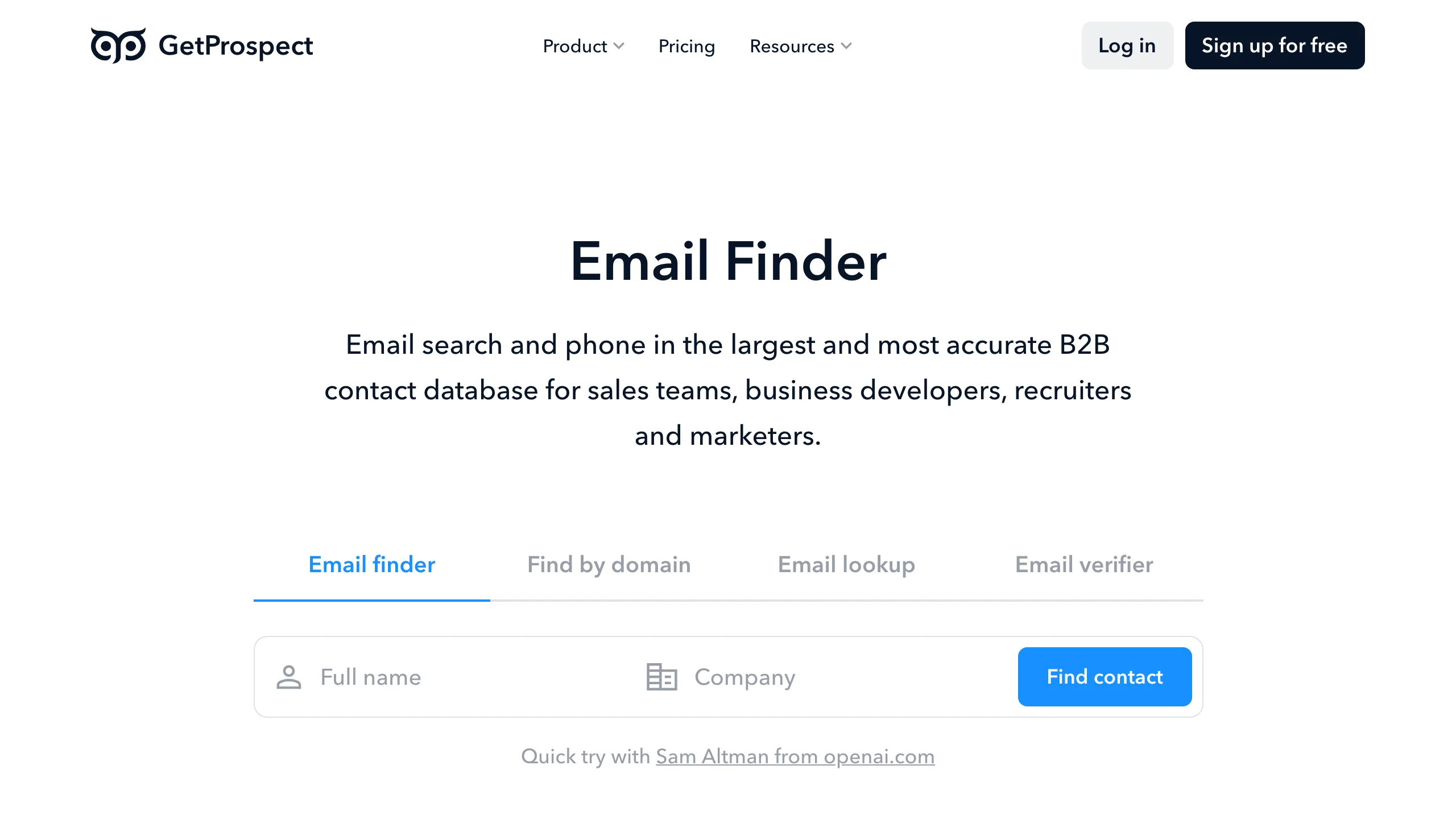
Counting in valid emails rather than credits removes a layer of arithmetic: $49 a month buys 1,000 addresses that actually resolved, plus 2,000 verifications, or $34 a month on annual billing. The genuinely distinctive thing for this audience is the free plan, which includes API access at 50 valid emails a month, something no other tool here offers without payment. At 4.0 across 41 G2 reviews it has the lowest verified rating in this comparison.
Key features
- checkAPI access on the free plan the only tool here that does this.
- checkCounted in valid emails not credits, so the plan number is the address number.
- checkVerification bundled 2,000 verifications alongside the 1,000 finds.
- checkLinkedIn extension and light CRM for profile-by-profile work.
Pros
- addFree plan includes API access
- addPlan counts addresses, not credits
- addVerification included with finding
Cons
- removeAround $49 per 1,000 at entry, the highest here
- remove4.0 on G2, lowest verified rating in this list
- removeReddit tests report accuracy well below its claim
The honest read
The free tier is the reason to look: it is the cheapest legitimate way to build against an API. Paid pricing is the weakest value on this page.
Tomba
Cheapest conventional finder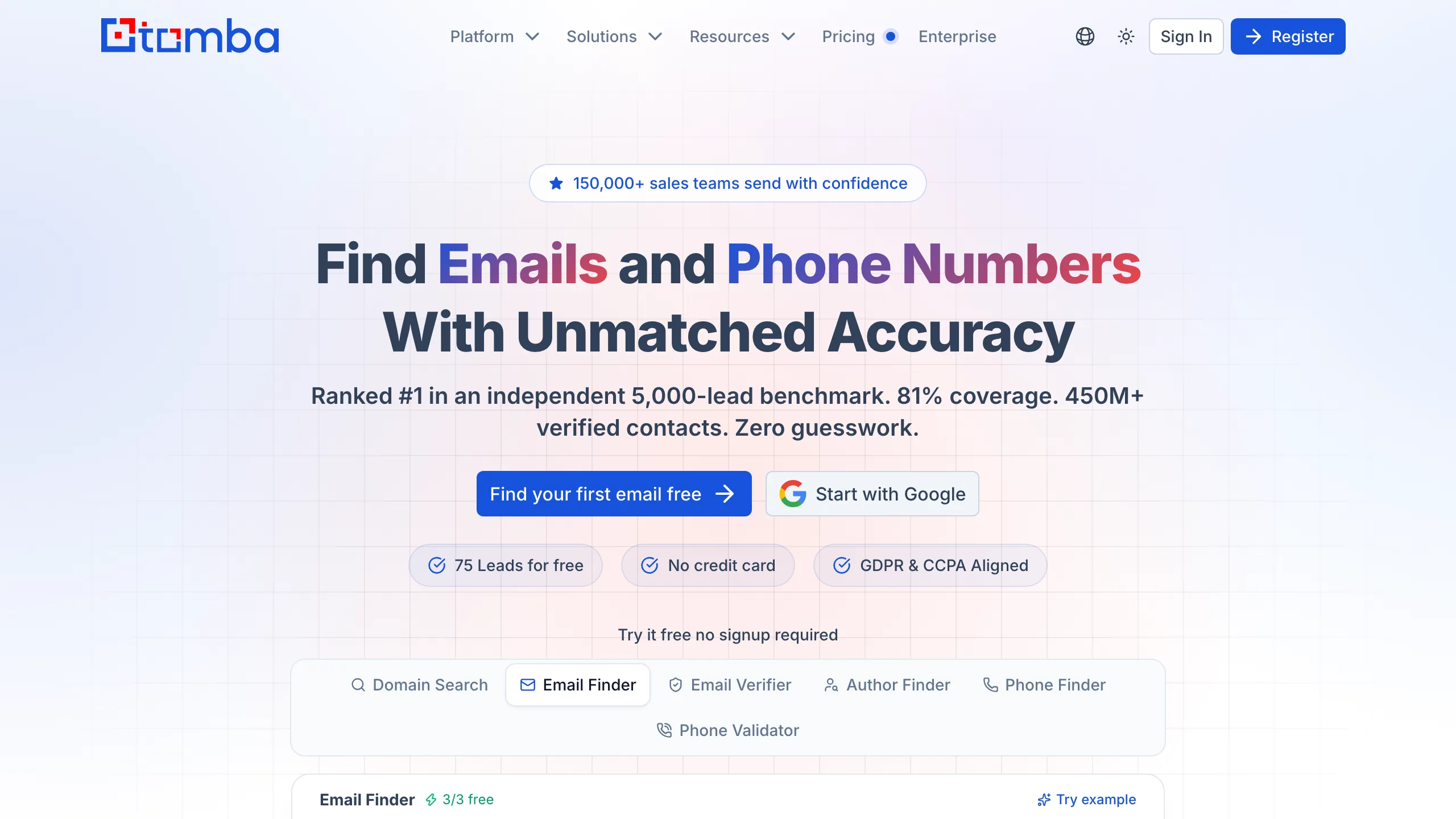
At $89 for 10,000 combined credits, Tomba works out near $8.90 per 1,000 found addresses, and it covers more endpoints than most: finder, domain search, verifier, author finder, phone finder. The free allowance is 75 lookups once rather than a recurring tier, so it functions as a trial. There is no verified G2 rating, which for a solo buyer means the coverage claims are worth testing on your own list before you commit.
Key features
- check2,500 credits for $29 the lowest unit cost among conventional finders here.
- checkSix endpoints on one key including an author finder with no real equivalent.
- checkDomain search included not sold as a separate product.
- checkTrial credits on signup a one-time allowance rather than a monthly tier.
Pros
- addCheapest conventional finder per address
- addWidest endpoint coverage on this list
- addLow entry price at $29
Cons
- removeFree allowance is one-time, not recurring
- removeNo verified G2 rating to judge it by
- removeCoverage claims are vendor-measured
The honest read
The best unit price here among the mainstream finders, with the least public evidence behind it. Spend the trial credits on your own rows before deciding.
Findymail
Highest rated, no free tier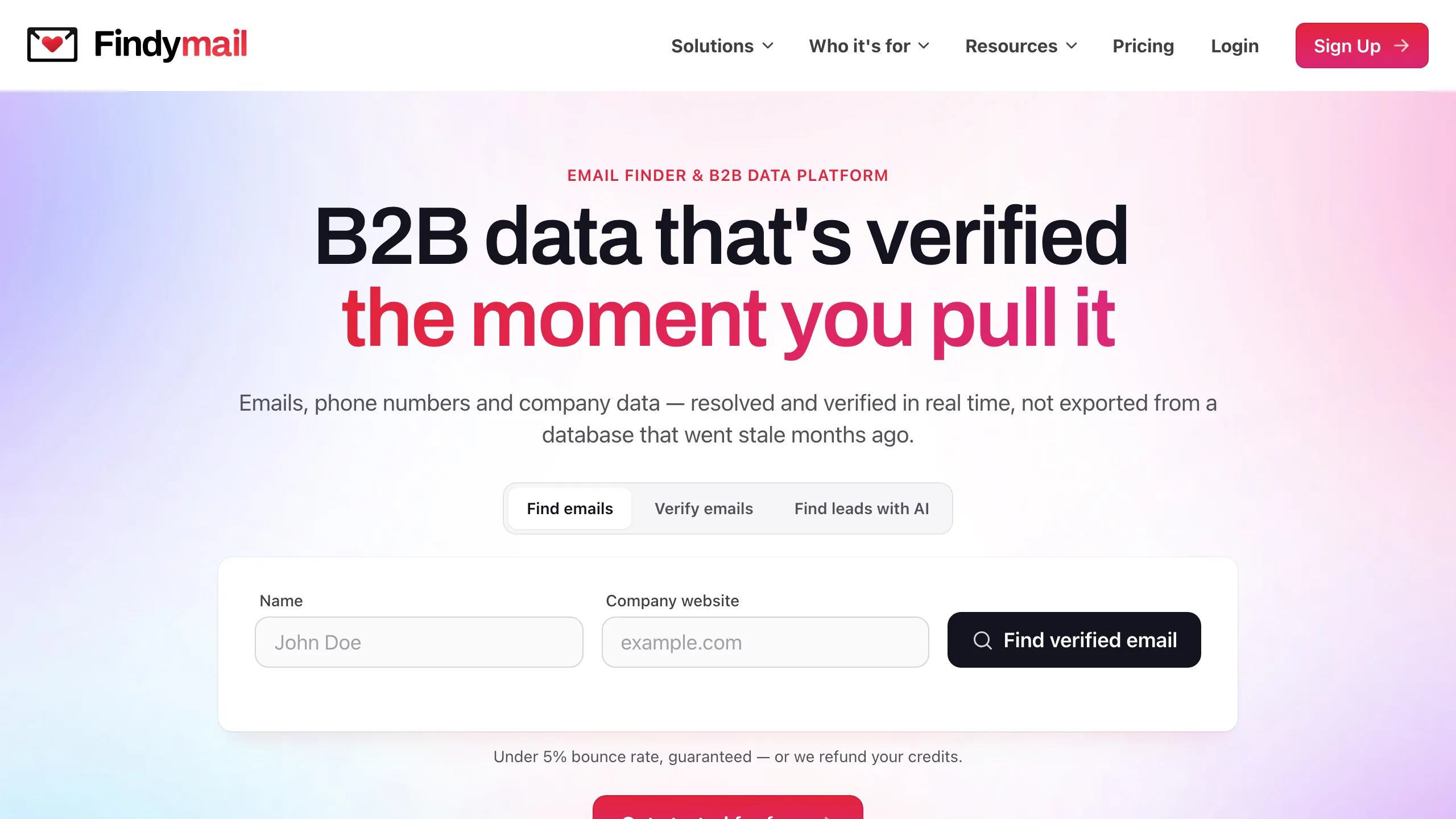
The highest verified rating in this comparison, 4.9 across 56 G2 reviews, and it comes from cold email operators who care about bounce rate above everything. Verification happens as part of finding and there is a bounce guarantee behind it. Pricing changed in 2026: the Starter plan is now $99 a month for 5,000 finder credits plus 5,000 verifier credits, around $19.80 per 1,000 found. The awkward part for this audience is that the entry point nearly doubled, and the free allowance is 10 credits once.
Key features
- checkVerification inside every find the basis of the bounce guarantee.
- checkAPI on all plans no tier gate on programmatic access.
- checkIntegrates with sending tools Lemlist, Instantly and Smartlead among others.
- check4.9 on G2 across 56 reviews the highest verified rating here.
Pros
- addHighest verified user rating on this list
- addVerification built into every find
- addAPI available on the entry plan
Cons
- removeEntry plan jumped to $99 a month
- removeFree allowance is 10 credits, one time
- removeNarrow focus on outbound use cases
The honest read
Loved by the people it is built for, and priced for teams whose cost per meeting dwarfs their cost per address. The missing free tier makes it a harder first purchase for a solo founder.
Voila Norbert
Simple, long-established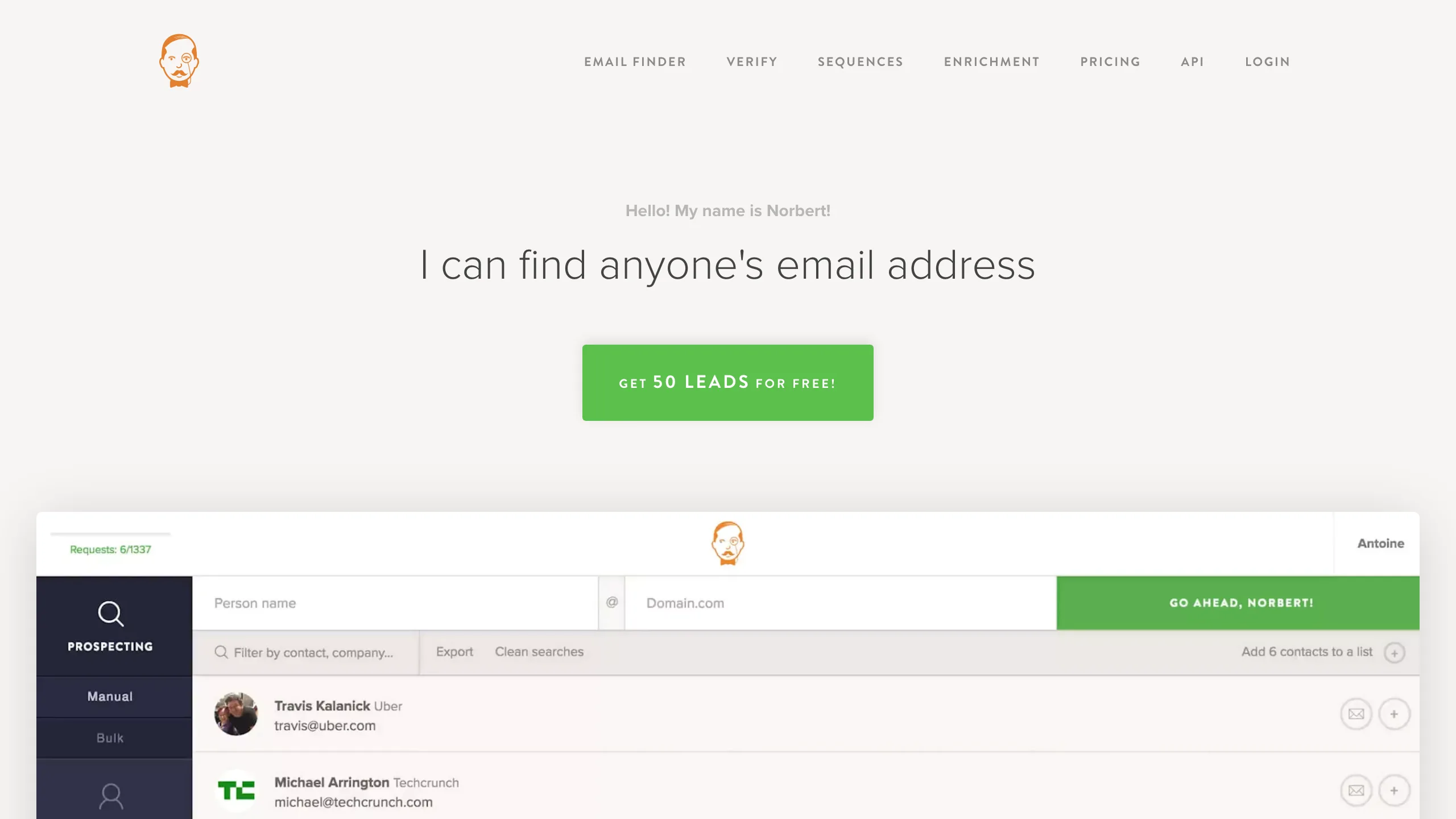
One of the older names here, doing the core job without much around it: name and company in, address out, with a bulk uploader and optional verification. Pricing runs $49 a month for 1,000 credits on the Valet plan, $39 on annual. The free allowance is 50 leads once. With 91 G2 reviews at 4.6 the people who buy it seem to keep it, and the Zapier and WordPress integrations suit non-technical users who would rather not touch an API.
Key features
- checkSingle and bulk finding CSV upload alongside the API.
- checkZapier and WordPress integrations for workflows without a developer.
- checkVerification available priced separately from finding credits.
- check4.6 on G2 across 91 reviews steady feedback over a long period.
Pros
- addStraightforward with no bundle to learn
- addWell rated over many years
- addGood no-code integration coverage
Cons
- removeAround $49 per 1,000 credits
- removeFree allowance is 50 leads, one time
- removeFewer features than newer rivals at the price
The honest read
Dependable and unexciting at a price newer tools have undercut. Reasonable if you value longevity, hard to justify on unit economics alone.
Anymailfinder
Lowest sticker, highest unit cost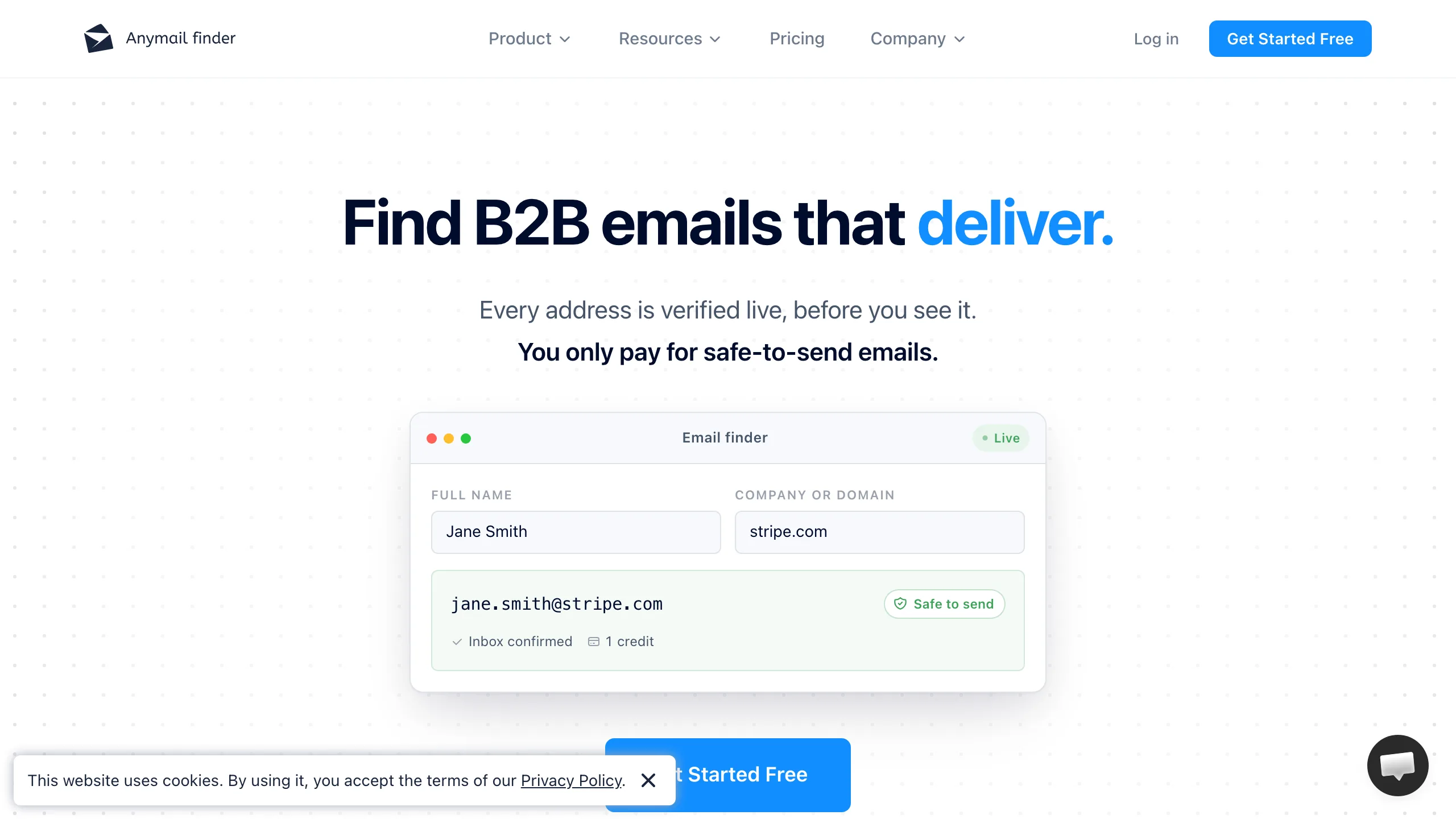
It bills only for verified results, which is the reason it belongs in a piece about cheap tools, but the plan is 50 credits, which works out around $280 per 1,000 found addresses, the highest unit cost here by a wide margin. The billing model is genuinely good: you are charged only when a verified address comes back, so misses cost nothing. Volume plans bring the rate down substantially. With 5 G2 reviews the public record is too thin to lean on.
Key features
- checkCharged on verified results only a miss costs nothing, which is the clearest model here.
- checkLowest monthly entry price $14, though for only 50 credits.
- checkBulk endpoint returns a file sensible for overnight jobs.
- checkDecision-maker search finds a role when you have no name.
Pros
- addPay only for verified addresses
- addLowest monthly commitment on this list
- addSimple, readable API documentation
Cons
- removeRoughly $280 per 1,000 at the entry plan
- removeOnly 5 G2 reviews to judge by
- removeTrial credits expire after 7 days
The honest read
The billing model deserves copying and the entry tier does not. Worth a look at volume where the unit price falls a long way, and a poor first purchase at $14.
Which one fits your situation
Pick by how you work, then check the arithmetic against the table.
| If this is you | Start here |
|---|---|
| You are one person and want a free tier you never outgrow | Mailsfinder gives 100 credits a day forever, which is roughly 3,000 a month, enough that many solo operators never pay. Skrapp gives 100 a month on the same forever basis. |
| You work from LinkedIn all day | Skrapp and GetProspect are built around the extension rather than bolting one on. Mailsfinder has no extension yet, so that workflow means exporting a CSV. |
| You need the lowest cost per address and volume is real | Mailsfinder at roughly $0.40 per 1,000 found is an order of magnitude below the rest of this list, because a find costs 3 credits out of a 75,000 credit pool. |
| You want one tool for finding and sending | Snov.io bundles 5,000 campaign recipients into its $39 plan, which is real money if you would otherwise pay for a sequencer separately. |
| You are prototyping an integration on no budget | GetProspect is the only tool here with API access on the free plan, at 50 valid emails a month. |
| You are about to hire your second person | Avoid per-seat pricing now rather than later. Apollo at $49 a user becomes $98 the day your co-founder logs in, while the workspace-priced tools do not move. |
Five pricing traps that catch small teams
All of them come from reading the monthly price instead of the unit cost.
Mistaking the cheapest plan for the cheapest tool
Anymailfinder bills only for verified results, so a miss costs nothing, but its smallest subscription tier is 400 credits a month. That is not published in USD to our region, so treat the sticker with care. Roughly $280 per 1,000 addresses, against roughly $24.50 at Hunter's $49 plan.
Counting a one-time trial as a free tier
Tomba's 75 lookups and Voila Norbert's 50 leads are one-time. Mailsfinder's 100 a day and Skrapp's 100 a month renew. For a solo operator that difference compounds every month.
Signing up per seat before you hire
Per-seat pricing is fine at one person and doubles at two. If you expect to add anyone in the next year, workspace pricing saves you a migration as well as money.
Paying monthly out of habit
Annual billing takes 20 to 30 percent off at most vendors here: Hunter from $49 to $34, Snov.io from $39 to $29.25, Skrapp from $39 to $30. On a solo budget that is a meaningful saving for no change in product.
Ignoring whether misses are billed
Some vendors charge for a search whether or not it returns an address. On a hard list with a 50 percent hit rate that doubles your true cost per contact, which no pricing page will show you.
Category picks
Free tier you can live on
Mailsfinder gives 100 credits a day forever with no card, which is roughly 3,000 a month before you pay anything.
Free tier that renews monthly
Skrapp.io gives 100 credits every month on a forever basis, with a mature LinkedIn extension behind it.
Best value for a single seat
Apollo packs 2,500 credits into $49 a user, which is strong value right up until the second person needs access.
Cheapest way to prototype an API
GetProspect is the only tool here offering API access on the free plan, at 50 valid emails a month.
Finding and sending on one bill
Snov.io includes 5,000 campaign recipients with its 1,000 credits at $39, or $29.25 on annual billing.
Lowest cost per address at volume
Tomba is roughly $11.60 per 1,000 found on its $29 plan, the cheapest of the conventional finders here.
What you actually pay
The same ten tools with what the entry plan actually includes. Where a tool charges per seat, remember to multiply by the number of people who need it.
| Tool | Free plan | Entry price | What the entry plan includes | Cost per 1,000 found, best plan |
|---|---|---|---|---|
| Mailsfinder | 100 credits a day, forever | $9.99/mo Starter | 75,000 credits a month | ~$0.4 |
| Skrapp.io | 50 credits, one time | $39/mo, $29 annual | 2,000 credits a month, 2 users | ~$19.50 |
| Apollo | 75 credits a month per user | $49/user/mo annual | 2,500 credits a user a month | ~$19.60 |
| Hunter | 50 credits a month, API included | $49/mo, $34 annual | 2,000 searches a month | ~$24.50 |
| Snov.io | 50 credits and 100 recipients a month | $39/mo, $29.25 annual | 1,000 credits plus 5,000 recipients | ~$39.00 |
| GetProspect | 50 valid emails a month, API included | $49/mo, $34 annual | 1,000 valid emails plus 2,000 verifications | ~$49.00 |
| Tomba | Trial credits on signup | $89/mo Growth | 10,000 credits, finder plus verification | ~$8.90 |
| Findymail | 10 credits, one-time trial | $99/mo Starter | 5,000 finder plus 5,000 verifier credits | ~$19.80 |
| Voila Norbert | 50 leads, one time | $49/mo Valet, $39 annual | 1,000 credits a month | ~$49.00 |
| Anymailfinder | 7-day trial | Smallest tier is 400 credits a month | 400 credits a month at the entry tier | Not in USD |